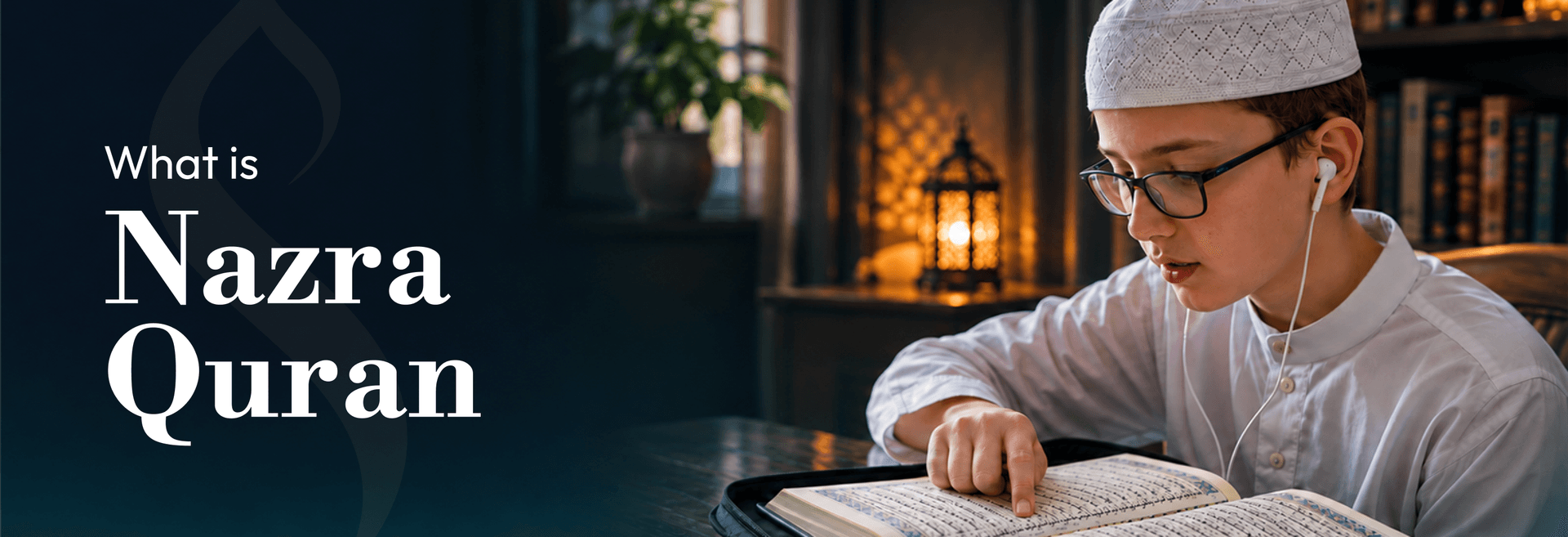

Many learners mix up Nazra and Tajweed. This guide shows what each one covers, how they overlap, and which one to learn first.
Nazra vs Tajweed: What Is the Difference and Which Comes First?
Nazra and Tajweed are two parts of learning the Quran, and many families mix them up. Nazra is the skill of reading the Arabic text from the Mushaf. Tajweed is the set of rules that decides how each letter and sound is pronounced. This guide explains the main difference, what each one covers, how much Tajweed already sits inside Nazra, and which one to start with. It also matches common learner situations to the right starting point.
What Is the Main Difference Between Nazra and Tajweed?
The main difference is that Nazra is reading the Quran from the Mushaf, and Tajweed is the set of rules for pronouncing it correctly. Nazra answers the question "Can the student read these words?" Tajweed answers the question "Does each letter and sound come out the right way?"
A student can read a page smoothly and still make sound mistakes. Another student can know every Tajweed rule on paper and still read slowly. Good recitation uses both skills.
Nazra and Tajweed differ on six points, listed side by side here.
Point | Nazra | Tajweed |
|---|---|---|
What it is | Reading the Quran from the Mushaf | The rules for pronouncing letters, sounds, stretches and stops |
Main skill | Recognizing letters, vowels and words, then reading with a steady flow | Placing each letter in its correct sound position and applying the rules |
Starting point | No Arabic needed. Learning starts with the letters, usually through the Noorani Qaida | Ability to read the Quran without help |
What the teacher checks | Right letter, right vowel, right word, steady pace | Where a sound is made, how long it stretches, which letters echo or carry a nasal sound |
Usual learners | Children from age 4, adult beginners, new Muslims | Readers who already read, imams, Hifz students, adults who suspect mistakes |
Result | The student reads the Quran independently | The recitation matches the taught pronunciation |
In short, Nazra builds the reading skill, and Tajweed refines the sound of that reading.
What Is Nazra Quran?
Nazra Quran is reading the Quran by looking at the Arabic text in the Mushaf. The word Nazra comes from the Arabic root for "to look".
Students learn the 28 Arabic letters, the short vowel marks (Fatha, Kasra and Damma), the long vowels and the rules for joining letters. After that, they read Juz Amma and then the full Quran. Most students begin with the Noorani Qaida, which takes 3 to 6 months. Fluent reading of the full Quran takes 12 to 18 months, and the exact time depends on the student.
The guide titled What Is Nazra Quran? covers the meaning, the spelling variations and the full learning order.
What Is Tajweed?
Tajweed is the set of rules for pronouncing the Quran correctly. The word comes from an Arabic root that means to make better or to perfect.
The rules cover 5 areas:
Makharij, the places in the mouth and throat where letters are made
Sifaat, the quality of each sound, such as heavy or light
Madd, the stretching of a sound
Ghunna, the nasal sound
Waqf and Ibtida, the rules for stopping and restarting
Surah Al-Muzzammil (73:4) tells the believers to recite the Quran in a slow, measured way, which is called tartil. Scholars have long explained that measured recitation includes pronouncing each letter correctly and knowing where to stop.
Pronunciation changes meaning. The word قَلْب (qalb) means heart. The word كَلْب (kalb) means dog. The letters ق and ك are made in different places in the mouth, and Tajweed teaches that difference.
Does Nazra Include Tajweed?
Yes, Nazra includes basic Tajweed. A Nazra course teaches 4 basic ideas:
Makharij: the place where each of the 28 letters is made
Madd: stretching a sound for 2 counts when a long vowel letter (Alif, Waw or Ya) follows a matching short vowel
Qalqalah: a light echo on the 5 letters ق ط ب ج د when they carry a sukoon
Ghunna: the nasal sound held for about 2 counts on a Noon or Meem with a shaddah
Teachers introduce these early because early correction keeps wrong sound habits from settling in. The detailed rules, such as the full Noon Saakin, Tanween and Meem Saakin rules, belong to a full Tajweed course.
What Does a Tajweed Course Add After Nazra?
A Tajweed course adds the full set of pronunciation rules and checks them across long stretches of recitation. The Quran Tajweed course at Tibyan Quran Academy has 4 modules:
Articulation points (Makharij) and common mispronunciations
Letter characteristics (Sifaat), including heavy and light letters, Qalqalah and Ghunna
The rules for Noon Saakin, Tanween and Meem Saakin, and for the heavy and light Lam
Madd types, and the rules for stopping (Waqf) and restarting (Ibtida)
The course ends with a test: reading one full Juz with Tajweed applied. Classes are one-to-one with teachers who hold an Ijazah in Hafs an Asim. The course asks for the ability to read the Quran from the Mushaf without help.
Which Should You Learn First, Nazra or Tajweed?
Learn Nazra first, then Tajweed. Tajweed rules apply to words, so the student reads the words first. Basic Tajweed starts inside Nazra from the early lessons, which means the two overlap at the beginning.
A common learning order has 3 stages:
The Noorani Qaida, which takes 3 to 6 months.
Nazra with basic Tajweed, from Juz Amma to the full Quran. Fluent reading of the full Quran takes 12 to 18 months.
A full Tajweed course.
The Nazra Quran course follows this order. A student who already knows some letters takes a placement check first and starts at a suitable level.
Which Option Fits Your Situation?
The right starting point depends on how well the learner reads today. This table covers 7 common situations.
Situation | Start with | Reason |
|---|---|---|
Cannot read Arabic letters yet | Nazra, beginning with the Noorani Qaida | Tajweed rules apply to words the learner can read |
Child aged 4 to 8 | Nazra | Letter recognition and steady pronunciation come first at this age |
Adult beginner or new Muslim | Nazra | Basic Tajweed comes along in the same lessons |
Reads slowly and stops often | Nazra | Reading fluency still needs work |
Reads smoothly but mixes sounds, such as ق and ك | Tajweed | The reading skill is in place and the sound needs rules and correction |
Imam, prayer leader or Hifz student | Tajweed | Other people hear the recitation, and memorized text needs correct sounds |
Learned as a child and is unsure of the level | A listening check with a teacher | The level decides the starting point |
A short listening check by a teacher settles unclear cases.
Is Tajweed Required for Every Reader?
Scholars differ on the ruling. One view makes applying Tajweed an individual duty. Another view limits the duty to the rules that protect letters and meanings, and treats the finer rules as recommended. A qualified scholar answers questions about a personal case.
What Happens When a Learner Skips One of Them?
A learner who skips Nazra cannot apply Tajweed, because the rules attach to words the learner cannot read yet. Learners who lean on transliteration also pick up sounds that Arabic letters do not match.
A learner who skips Tajweed keeps the same sound mistakes. Common ones are mixing ح and ه, ق and ك, or ص and س. Reading a page fluently with the same mistake repeated on every line makes the habit stronger.
How Do Nazra and Tajweed Work Together in One Class?
In a 30-minute one-to-one class, the teacher listens to each line and corrects reading errors and sound errors in the same lesson.
Reading errors include a wrong letter, a wrong vowel or a skipped word. Sound errors include a stretch that is too short, a missing echo on a Qalqalah letter, or a throat letter made in the mouth. Students at the Nazra stage get both kinds of correction at a beginner level. Students in a Tajweed course get detailed sound correction on text they already read well.
Frequently Asked Questions About Nazra and Tajweed
Is Nazra the same as Tajweed?
No. Nazra is reading from the Mushaf, and Tajweed is the rule set for pronouncing that reading. Nazra includes basic Tajweed, and a Tajweed course covers the full set of rules.
Can a child learn Tajweed without Nazra?
A child hears and copies correct sounds from the first class. Formal Tajweed rules start after the child reads words without help.
Can Nazra and Tajweed be learned at the same time?
Yes, at the basic level. Nazra lessons include basic Tajweed. A full Tajweed course starts once the student reads the Quran without help.
Does Tajweed change the meaning of the Quran?
No. Tajweed protects the meaning. Wrong pronunciation can change a word, as قَلْب (heart) and كَلْب (dog) show.
Can adults learn Tajweed without a teacher?
Apps and videos help with listening. A teacher hears the learner's own mistakes and corrects them, and that correction is the main benefit of a class.
How long does Tajweed take after Nazra?
The time depends on the student's reading level and practice. The Tajweed course ends with reading one full Juz with Tajweed applied, so the teacher sets the pace from that goal.
Nazra vs Tajweed: The Short Answer
Nazra is the reading skill, and Tajweed is the rule set for pronouncing that reading correctly. Nazra comes first, with basic Tajweed included, and a full Tajweed course follows once the student reads without help. A free trial class lets a teacher listen to the learner and place them at the right level.
Ready to Start Your Quran Journey?
Join thousands of students learning Quran online with certified teachers at Tibyan Quran Academy.
Book a Free Trial Class