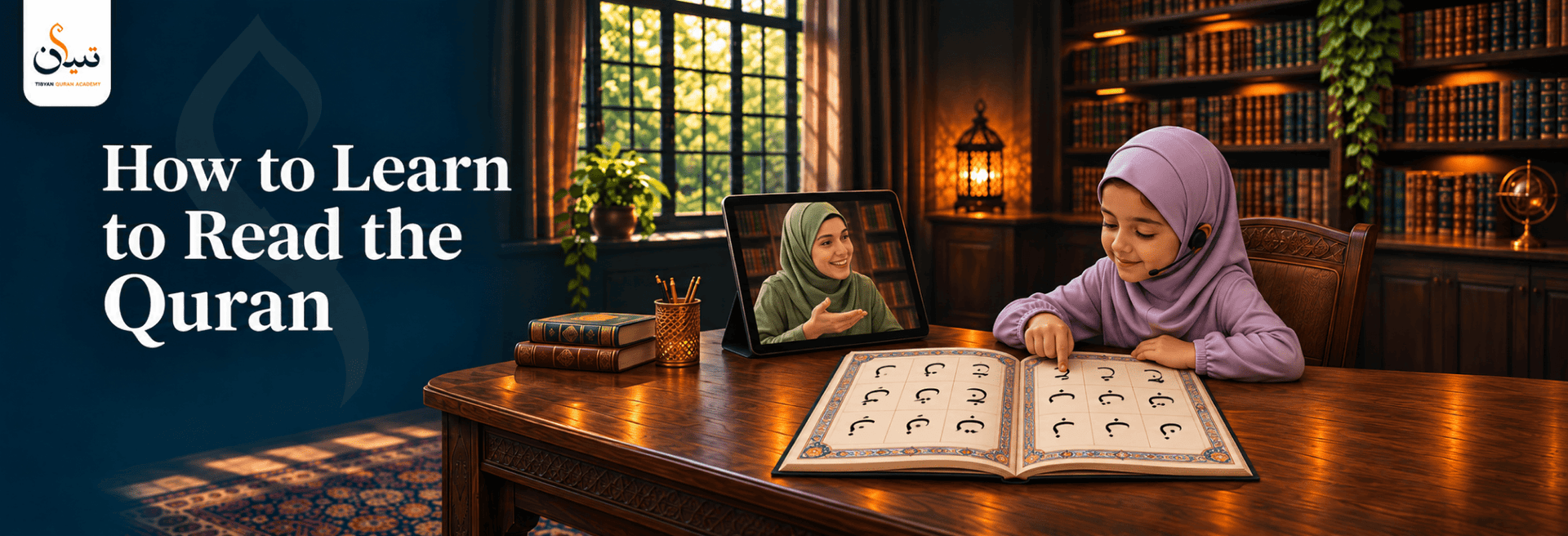
Learning to read the Quran starts with the Arabic letters and builds one skill at a time. This guide shows the steps in order, how long each one takes, and how to begin even if you have never read Arabic before.
How to Learn to Read the Quran
You learn to read the Quran by starting with the Arabic letters, then the vowel marks, then joining letters into words, and then reading short surahs until you can read the whole Quran on your own.
You do not need to know Arabic first. You do not need to memorize anything first. Reading is the first skill, and it is built one small step at a time. Children, adults, and new Muslims all begin in the same place, with the letters.
This guide explains what reading the Quran means, what you need before you start, the steps in order, how long it takes, and how to begin.
What Does It Mean to Read the Quran?
Reading the Quran means reading the Arabic text from the Mushaf, out loud, with correct letters and vowels. This kind of reading is called Nazra. The student looks at the page and reads each word as it appears.
Reading is not the same as memorizing. A student who memorizes recites from memory, while a student who reads looks at the text. Reading is also not the same as understanding. A student can read Arabic fluently without knowing the meaning of every word. Understanding comes later, through translation and Tafseer.
Reading is the skill that makes everything else possible. You cannot memorize correctly if you cannot read correctly. You cannot apply Tajweed rules to words you cannot read yet. That is why reading always comes first.
What Do You Need Before You Start?
Very little. A Qaida book or a Mushaf, a quiet place to sit, and a teacher who can hear you read.
You do not need a full set of books. You do not need to buy a course first. A Noorani Qaida is enough for the first months, and your teacher will tell you when to move to the Mushaf. If you learn online, you also need a device with a working camera and microphone, so the teacher can see your book and hear your voice.
A fixed time helps more than a long time. A short lesson at the same hour each day builds a habit that a long lesson once a week cannot. Keep a notebook near you for the letters or rules you keep forgetting, and keep your Qaida in one place so you are not searching for it when the class starts.
How Do You Learn to Read the Quran Step by Step?
You build the skill in six steps, and each step rests on the one before it. A student who rushes past the letters will struggle with the words. A student who learns the letters well will find the words easy.
Arabic letters and their sounds. You learn all 28 letters, their shapes alone and joined, and the place in the mouth and throat where each sound is made. This is the base of everything. Letters that look alike, such as ب and ت and ث, get special attention here.
Short vowels and doubled sounds. You learn Fatha, Kasra, and Damma, then Tanween and Shaddah. These small marks decide the sound of each letter, and a wrong vowel can change a word.
Long vowels and silent letters. You learn the three Madd letters, Alif, Waw, and Ya, how long to hold each one, and how to read Sukoon. This is where reading starts to sound smooth instead of broken.
Joining and connecting rules. You learn Sun and Moon letters, joined words, and the stopping signs in the Mushaf. Letters change shape at the start, middle, and end of a word, and this step teaches you to read them in every position.
Reading short surahs. You move from the primer to the Mushaf, often starting with short surahs from Juz Amma, the 30th part. Surah Al Fatiha usually comes first, because it is read in every prayer.
Fluent reading of the whole Quran. You read through all 30 Juz with a steady pace while the teacher helps correct the mistakes that keep coming back. Speed comes last. Accuracy comes first.
Our Nazra Quran course follows this order, so each stage prepares you for the next one.
Stage | What you learn | Typical time | What you can do at the end |
|---|---|---|---|
Noorani Qaida | Letters, short vowels, joining rules | 3 to 6 months | Read letters, vowels, and short words with growing confidence |
Juz Amma reading | Short surahs from the Mushaf | A few months after the Qaida | Read short surahs slowly but correctly |
Full Quran reading | All 30 Juz with a steady pace | Around 12 to 18 months from the start | Read pages of the Quran with improved fluency and accuracy |
How Long Does It Take to Learn to Read the Quran?
Most students read the full Quran fluently in 12 to 18 months, and the first letters take only a few weeks. These are general estimates, not fixed deadlines. The exact time depends on the student.
Four things change the timeline more than anything else.
Class frequency. Two or three classes each week keep the learning fresh. One class a week works too, but it takes longer.
Daily practice. A short period of reading practice each day matters more than one long session at the weekend. Ten to 15 minutes a day is enough for most students.
Age. Younger children need shorter lessons and more repetition. Adults may understand the rules quickly but still need practice with sounds that do not exist in their first language.
Prior experience. A student who already knows the Arabic letters can start further ahead after a short assessment. A student who starts from zero begins with the letters, and that is normal.
A simple week of practice looks like this.
Day | What to do | Minutes |
|---|---|---|
Class days, 2 or 3 days a week | Learn the new lesson with your teacher | 30 |
Every day | Read aloud what you learned in class | 10 to 15 |
Once a week | Go back over the last few lessons and read them again | 15 |
Listening | Listen to a slow recitation of the surah you are reading | 10 |
The goal is not to finish quickly. The goal is to build correct reading habits that stay with you.
Should You Learn on Your Own or With a Teacher?
A teacher is the fastest way to learn, because reading is a sound skill and you cannot hear your own mistakes. You may read a letter wrong for weeks without knowing it. A teacher hears it in the first class and corrects it before it becomes a habit.
Apps and videos can help. They are good for listening, for learning letter names, and for revision between classes. But an app cannot hear your voice and tell you that your ق sounds like a ك, or that your stretch is too short. That correction is the main benefit of a class.
Self study can teach you the shapes of the letters. It cannot teach you how your own reading sounds. If you learn alone, book a listening check with a teacher from time to time, so mistakes do not settle in.
What If You Are an Adult or a New Muslim?
You start in the same place as a child: the letters. Age does not change the order of learning. It only changes the pace, and adults often move through the rules faster than children do.
Many adults feel shy about starting late. They worry that they should have learned as a child, or that they will be slow. That feeling is common, and it passes quickly once the letters start to make sense. A hadith narrated by Aisha, may Allah be pleased with her, in Sahih al Bukhari and Sahih Muslim, explains that a person who recites the Quran with difficulty and struggles through it receives a double reward. Difficulty at the start is not a reason to wait. It is part of learning.
New Muslims often begin with Surah Al Fatiha and the short surahs used in Salah, so prayer becomes easier while reading improves. You learn the letters, then the surahs you need every day, then the rest of the Quran in order. Your teacher will set the pace with you, not for you.
How Can Parents Help Children Learn to Read the Quran?
Short lessons at the same time every day help more than long lessons once in a while. A child who reads for 15 minutes after school each day will pass a child who reads for an hour on Saturday and then stops.
A few things help at home.
Keep the time fixed. The same hour, the same chair, the same Qaida. Children learn faster when reading has a place in the day.
Read together. Sit near your child while they read, even if you cannot read Arabic yourself. Your presence tells them this matters.
Praise the effort, not the speed. Tell them when a hard letter comes out right. Speed grows on its own when accuracy is praised.
Let the teacher correct. If you hear a mistake, do not stop your child after every word. Note it and let the teacher handle it in class, so reading stays a happy time and not a test.
Mark the milestones. The first full surah, the first Juz, the first full reading of the Quran. In many South Asian families the first full reading is marked with a small gathering called an Ameen or Khatm, with dua for the student.
What Mistakes Slow You Down?
A few mistakes come up again and again. They are easy to avoid once you know them.
"I will rush to the Quran." Students who skip the Qaida reach Quranic text too early and then struggle with every line. The Qaida feels slow, but it is what makes the Quran easy later.
"Transliteration is enough." Reading the Quran in English letters feels easier at first, but English letters cannot show Arabic sounds. Students who lean on transliteration pick up sounds that Arabic letters do not match, and they have to unlearn them later.
"I will learn from videos alone." Videos teach you how reading should sound. They cannot hear how your reading sounds. Without a teacher, the same mistake can repeat on every page.
"I must finish fast." Students who chase a deadline read quickly and carelessly. Reading slowly and correctly for a year beats reading quickly and wrongly for a month.
"I will compare myself with others." Every student has a different start. A child of four and an adult of forty are not on the same clock. The only fair comparison is with your own reading last month.
How Do Nazra and Tajweed Fit In?
Basic Tajweed is part of Nazra from the early lessons, and a full Tajweed course comes after you can read. You do not learn Tajweed instead of reading. You learn it inside reading, one rule at a time.
A Nazra course teaches four basic ideas early: Makhraj, the place where each letter is made; Madd, stretching a sound for two counts; Qalqalah, a light echo on five letters when they carry a Sukoon; and Ghunna, the nasal sound held for about two counts. The full rules, such as the rules for Noon Saakin, Tanween, and Meem Saakin, belong to a Tajweed course that starts once you read the Quran without help.
If you are unsure which one you need first, read our comparison of Nazra and Tajweed. It explains the difference in plain words and matches common situations to the right starting point.
How to Start Learning to Read the Quran
Starting is simple. A few preparations make the first lesson easier.
Book an assessment or trial class so a teacher can find your starting level.
Choose a class schedule you can follow every week.
Set up a device with a working camera and microphone in a quiet place.
Keep a Noorani Qaida book or a Mushaf ready. Your teacher may also share learning material on screen.
Set aside a little time for reading practice between classes.
Choose a male or female teacher according to your family preference.
At Tibyan Quran Academy, reading is taught in live one to one classes of 30 minutes. Each student works with a teacher who listens to their recitation and corrects mistakes during the lesson. This individual attention lets the teacher focus on your reading level and your learning needs.
When you are ready, book a free trial class. The teacher can listen to your reading and recommend a suitable starting point.
Frequently Asked Questions About Learning to Read the Quran
Can I learn to read the Quran if I do not know Arabic?
Yes. Most students start with no Arabic at all. The Noorani Qaida teaches the letters and the vowel marks from zero, and you learn to read Arabic script before you learn the Arabic language. Knowing Arabic helps later, but it is not needed to start reading.
How old should my child be to start?
Many children begin with Noorani Qaida from around age four, using short lessons suited to their attention span. There is no single right age. A child who can sit for 15 minutes and repeat sounds is ready to begin.
Do I need to memorize the Quran to read it?
No. Reading and memorizing are different skills. Reading means looking at the text and reading it aloud. Memorizing means reciting from memory. Most students learn to read first and begin memorization later, once their reading is accurate.
How much should I practice every day?
Ten to 15 minutes of reading aloud each day is enough for most students. Short and regular beats long and rare. If you have more time, add listening to a slow recitation, but keep the reading practice itself short and steady.
Is Nazra the same as Tajweed?
No. Nazra is reading the Quran from the Mushaf. Tajweed is the set of rules that helps you recite it with correct pronunciation. Nazra includes basic Tajweed, and a full Tajweed course covers the complete set of rules.
How to Learn to Read the Quran: The Short Answer
You start with the 28 Arabic letters, then the vowel marks, then joining rules, then short surahs from Juz Amma, and then the whole Quran. Most students read fluently in 12 to 18 months with two or three classes a week and a little practice each day. A teacher makes the path faster because a teacher hears the mistakes you cannot hear yourself. A free trial class lets a teacher listen to your reading and place you at the right level, so your first lesson starts exactly where you are.
Ready to Start Your Quran Journey?
Join thousands of students learning Quran online with certified teachers at Tibyan Quran Academy.
Book a Free Trial Class