Learn Noorani Qaida lesson by lesson, from Arabic letters and vowel marks to Sukoon, Tashdeed and Quran reading practice. A simple guide for children and beginners.
Noorani Qaida Lesson by Lesson Guide for Beginners
Learning to read the Quran in Arabic is a beautiful goal, but many beginners do not know where to start. Some people can recognize a few Arabic letters, while others have never studied Arabic before. For both, Noorani Qaida provides a simple way to begin learning Quran reading.
Noorani Qaida teaches Arabic letters, their sounds, vowel marks and the basic rules needed to read Quranic words. Each lesson introduces a new skill and helps students prepare for the next one.
In this guide, we will explain Noorani Qaida lesson by lesson, what students learn in each stage, how to practice at home and when they can begin reading the Quran.
What Is Noorani Qaida?
Noorani Qaida is a beginner learning book used to teach people how to read the Quran in Arabic. It is commonly taught to children, adults and new Muslims who want to develop their Quran reading skills.
The book starts with individual Arabic letters and gradually introduces more difficult reading rules. Students learn how letters are joined, how vowel marks change their sounds and how different letters are pronounced together.
The main purpose of Noorani Qaida is to help students read Arabic words correctly before they begin regular Quran reading.
It is often the first step in learning Nazra Quran, which means reading the Quran directly from the Arabic text.
If you want to understand this learning method in more detail, explore and enroll in our Nazra Quran course to learn the Noorani Qaida step by step.
Noorani Qaida Lessons at a Glance
Different Noorani Qaida books may divide the lessons differently. The following table shows a common learning sequence used in many South Asian editions.
Lesson | Topic | What Students Learn |
|---|---|---|
1 | Single Arabic letters | Recognize and name Arabic letters |
2 | Joined letters | Read letters in different joined forms |
3 | Huroof Muqatta'at | Recognize special letters at the beginning of some surahs |
4 | Harakat | Read letters with Fatha, Kasra and Damma |
5 | Tanween | Read double vowel marks |
6 | Harakat and Tanween practice | Read letters and words with different vowel marks |
7 | Standing vowel marks | Learn longer vowel sounds |
8 | Madd and Leen | Understand long vowels and soft sounds |
9 | Combined practice | Read words using different vowel rules |
10 | Sukoon or Jazm | Read letters without a vowel |
11 | Sukoon practice | Join letters with Sukoon smoothly |
12 | Tashdeed | Read doubled letters |
13 | Tashdeed practice | Practice words with Shaddah |
14 | Tashdeed with Sukoon | Read combined letter patterns |
15 | Tashdeed with Tashdeed | Practice words containing more than one doubled letter |
16 | Tashdeed after Madd | Learn longer sounds with doubled letters |
17 | Final revision | Practice different rules together |
Some editions include additional lessons on Noon Sakinah, Tanween, Qalqalah and stopping signs. Your teacher may introduce these topics separately or as part of the final lessons.
Noorani Qaida Lesson by Lesson Explained
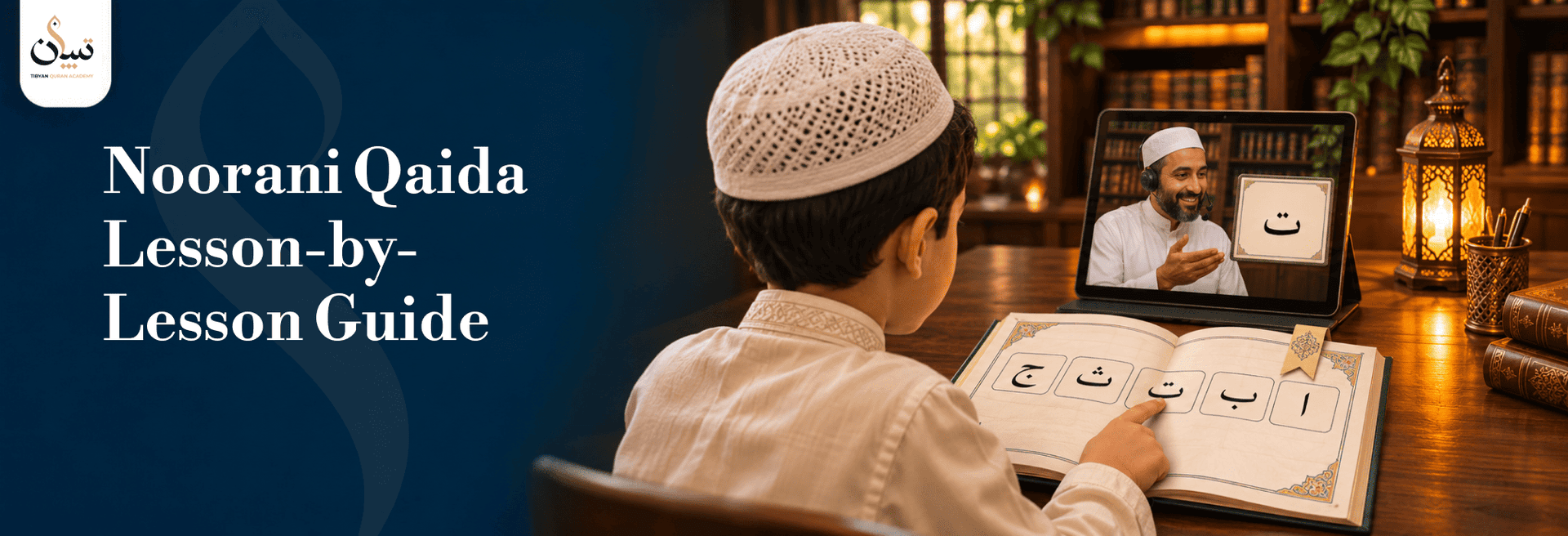
Lesson 1: Learning the Arabic Alphabet
The first lesson introduces the Arabic letters. Students learn their names, shapes and the number and position of their dots.
Some letters look very similar. For example, ب, ت and ث have a similar basic shape, but their dots are different.
At this stage, students should focus on recognizing each letter clearly.
Practice tip: Ask the student to identify letters in a random order instead of always reading them from Alif to Ya. This helps them recognize each letter independently.
Lesson 2: Joined Arabic Letters
In the second lesson, students learn how Arabic letters connect to form words.
Arabic is written from right to left, and many letters change their shape depending on their position in a word.
Students practice recognizing letters at the beginning, middle and end of words.
This lesson is important because the Arabic letters in the Quran do not always look exactly like the letters shown separately in the alphabet.
Lesson 3: Huroof Muqatta'at
Huroof Muqatta'at are special letters that appear at the beginning of some Quranic surahs.
Examples include الم at the beginning of Surah Al Baqarah and يس at the beginning of Surah Ya Sin.
These letters are read by their individual names rather than as an ordinary joined word.
A teacher helps students learn their correct pronunciation and the proper length of their sounds.
Lesson 4: Harakat
Harakat are the short vowel marks used with Arabic letters.
Students learn three basic marks:
Mark | Name | Example | Sound |
|---|---|---|---|
َ | Fatha or Zabar | بَ | Ba |
ِ | Kasra or Zer | بِ | Bi |
ُ | Damma or Pesh | بُ | Bu |
This is one of the most important lessons in Noorani Qaida because students begin reading letter sounds instead of only naming letters.
They should learn to keep these vowel sounds short and clear.
Lesson 5: Tanween
Tanween consists of double vowel marks at the end of a letter.
Students learn:
Mark | Name | Sound |
|---|---|---|
ً | Fathatain | An |
ٍ | Kasratain | In |
ٌ | Dammatain | Un |
Tanween helps students understand how Arabic words are pronounced at the end.
Students should practice reading words with all three marks and avoid adding extra sounds.
Lesson 6: Harakat and Tanween Practice
This lesson combines the short vowel marks and Tanween.
Students read different letters and words with Fatha, Kasra, Damma and double vowel marks.
The purpose is to help them recognize the marks quickly without stopping to think about every letter.
Regular practice makes the next lessons easier.
Lesson 7: Standing Vowel Marks
Some Noorani Qaida editions introduce standing Fatha, standing Kasra and inverted Damma in this stage.
These marks represent longer vowel sounds.
Students learn how to recognize them and how they differ from ordinary short vowel marks.
A teacher should explain the correct length of each sound so that students do not shorten or stretch it unnecessarily.
Lesson 8: Madd and Leen
Madd means lengthening a vowel sound. Students learn how certain Arabic letters create longer sounds when they appear in specific combinations.
The common Madd letters are Alif, Waw and Ya when they meet the required vowel conditions.
Leen letters are Waw and Ya with Sukoon after Fatha. They produce a soft sound and are taught separately from ordinary long vowels.
Students should listen carefully to their teacher and practice the difference between short and long sounds.
Lesson 9: Combined Reading Practice
At this stage, students practice different vowel marks and reading patterns together.
They may read words containing Harakat, Tanween, Madd and Leen.
The goal is to move away from reading every letter separately and begin reading complete words more smoothly.
Lesson 10: Sukoon or Jazm
Sukoon is a mark that shows a letter has no vowel sound of its own.
For example:
قُلْ
The letter ل has Sukoon, so it is joined to the sound before it.
Students learn how to connect letters without adding an extra vowel after a letter with Sukoon.
This lesson can be difficult for beginners, so slow practice is important.
Lesson 11: Sukoon Practice
This lesson gives students more practice with letters carrying Sukoon.
They learn to read different combinations of letters and pronounce the words without unnecessary pauses.
A common mistake is adding an extra sound after a letter with Sukoon. A teacher should correct this carefully.
Lesson 12: Tashdeed or Shaddah
Tashdeed is the mark that shows a letter is doubled.
For example:
رَبِّ
The letter ب carries Shaddah. It is pronounced as a doubled letter, not as a single light sound.
Students learn how to pronounce the letter with the correct strength and timing.
Lesson 13: Tashdeed Practice
Students practice words that contain Shaddah in different positions.
They learn to combine the doubled sound with the vowel marks and read the word without breaking it into separate parts.
This lesson helps improve accuracy and fluency.
Lesson 14: Tashdeed with Sukoon
In this lesson, students practice combinations of Shaddah and Sukoon.
These patterns require careful pronunciation because the learner must recognize which letter is doubled and how the sounds connect.
The teacher should encourage students to read slowly before increasing their speed.
Lesson 15: Tashdeed with Tashdeed
Students practice words containing more than one letter with Shaddah.
This helps them become comfortable with more complex Arabic words.
They should focus on reading the complete word correctly rather than rushing through the sounds.
Lesson 16: Tashdeed After Madd
This lesson introduces combinations of Madd and Shaddah.
Students learn how a long vowel can appear before a doubled letter and how the sound should be lengthened according to the rule being taught.
A familiar example appears in the final word of Surah Al Fatiha:
الضَّالِّينَ
A teacher should explain the correct recitation and help students practice the length of the sound.
Lesson 17: Final Revision
The final lesson brings together the rules students have learned throughout Noorani Qaida.
They practice words containing short vowels, Tanween, Madd, Sukoon and Shaddah.
Some editions also introduce additional Tajweed rules in this final stage.
The purpose of revision is to make sure students can read different patterns without depending on memorizing the examples.
How Long Does It Take to Complete Noorani Qaida?
The time required depends on the student's age, previous experience, practice routine and the number of lessons taken each week.
Some students learn the basic lessons quickly, while others need more time to recognize letters and pronounce them correctly.
Student | Suggested Learning Approach |
|---|---|
Young children | Short lessons with regular revision |
Older children | Daily reading practice with teacher guidance |
Adult beginners | Step by step learning at a comfortable pace |
New Muslims | Focus on Arabic letters and basic pronunciation first |
There is no need to rush through the book. A student should understand and read a lesson correctly before moving to the next one.
Tips for Learning Noorani Qaida at Home
Parents can support their children by making Quran practice part of their daily routine.
Here are some simple tips:
Practice for a short time every day.
Revise the previous lesson before starting a new one.
Listen carefully to the teacher's pronunciation.
Avoid guessing the sounds of unfamiliar letters.
Use a clear Noorani Qaida book with readable Arabic letters.
Encourage the student without making them feel worried about mistakes.
A little daily practice is often more helpful than studying for a long time only once or twice a week.
When Should Students Start Reading the Quran?
Students can begin reading the Quran when they can recognize Arabic letters, understand the vowel marks and read basic words with reasonable accuracy.
They do not need to be perfect before starting, but they should have a strong foundation.
A qualified Quran teacher can assess their reading and decide when they are ready to begin Nazra Quran.
If you want to learn more about the complete process, read our guide on how to learn to read the Quran.
Conclusion
Noorani Qaida is an important first step for anyone who wants to learn Quran reading. It takes students from recognizing individual Arabic letters to reading words with different vowel marks and pronunciation rules.
Each lesson builds on the previous one, so regular practice and careful revision are important.
With the help of a qualified teacher, children and adults can gradually develop the skills needed to read the Quran directly from the Mushaf.
At Tibyan Quran Academy, students learn Quran reading step by step with personal guidance from qualified teachers. Whether you are starting from the Arabic alphabet or helping your child begin Quran learning, a strong foundation in Noorani Qaida can make the journey easier.
Ready to Start Your Quran Journey?
Join thousands of students learning Quran online with certified teachers at Tibyan Quran Academy.
Book a Free Trial Class